
Practice Like You Play: Why Authentic Practice Improves Performance
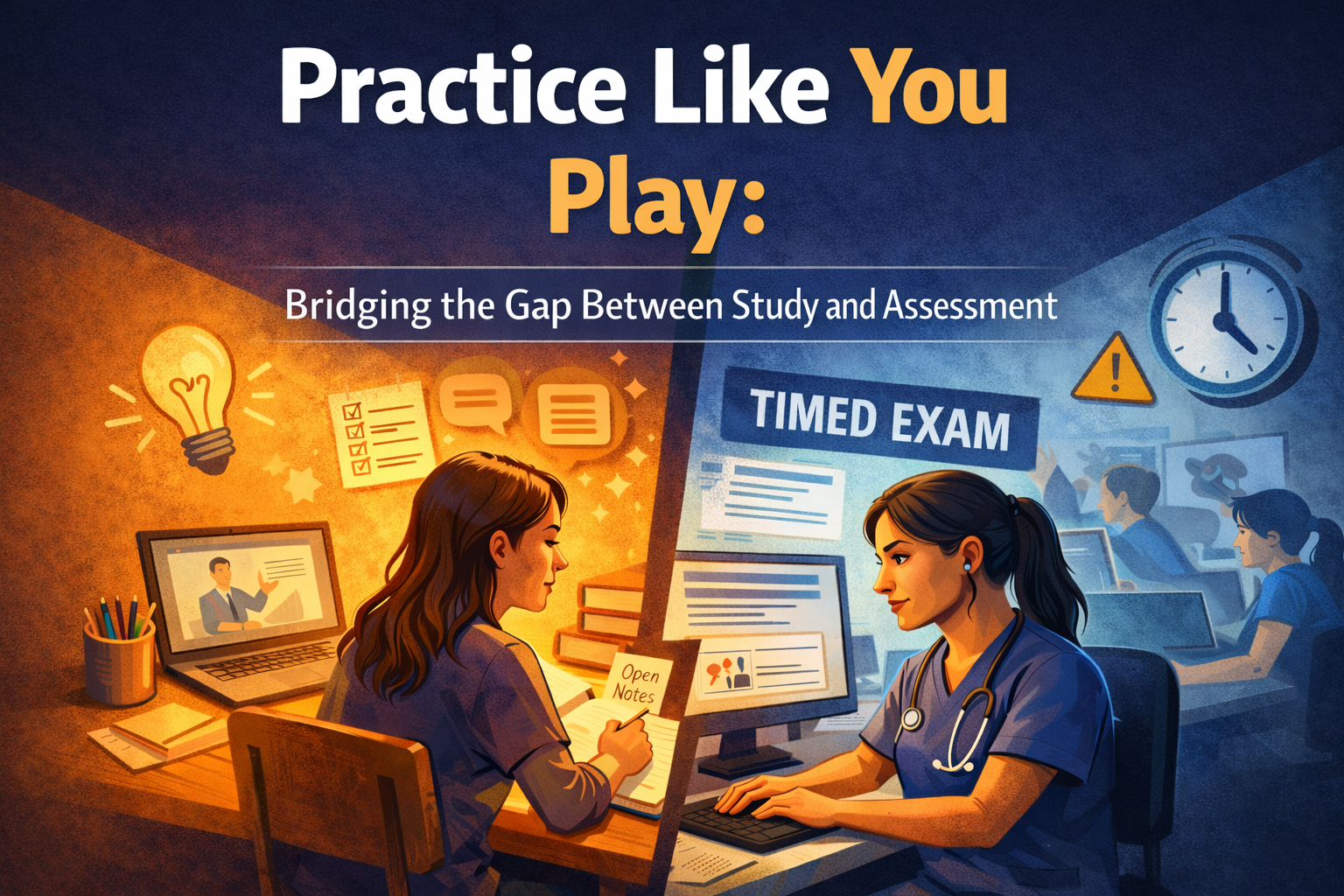
Have you ever watched a student do great on homework, then freeze during the exam?
That gap is often not about intelligence or effort. It is about conditions. When learners practice in one set of conditions (open notes, familiar formats, low pressure) and are assessed in another (timed, unfamiliar formats, higher stakes), performance can drop even when understanding is strong.
This challenge is becoming more visible as assessments across higher education shift toward measuring performance, decision-making, and applied reasoning rather than simple recall.
This article explores the Practice Like You Play instructional design principle, why authentic practice improves transfer, and how it applies across disciplines. Nursing and NCLEX preparation will be our running example because the stakes and assessment formats are clear, but the takeaways are relevant for any program preparing students for real-world performance.
Practice Like You Play Overview
Practice Like You Play is an evidence-based principle built on a simple truth: in the middle of an assessment or real-life situation, learners tend to use their knowledge and skills in similar ways to how they learned and practiced them.
That means instructors should design practice activities and assessments that resemble the conditions where learners will ultimately be expected to perform. This does not require perfect realism. It does require intentional choices about what must stay authentic, such as the format, the thinking required, the constraints, and the environment.
Before going further, this short video captures the idea clearly and quickly. It explains the principle using both a sports example and a test-prep example, and highlights an important nuance about authenticity.
Video summary: Practice should look like performance. The video uses sports and test-prep examples to show why authenticity matters and how to make smart tradeoffs when perfect realism is not feasible.
The same idea shows up in education when students practice with the same types of tasks they will later be graded on or expected to perform in the workplace.
Why Authentic Practice Changes Outcomes
Authentic practice matters because it improves transfer. Learners do not just need to remember information, they need to recognize when and how to apply it under realistic constraints.
Research supports this. A 2020 meta-analysis on simulation-based learning found that learning activities with a high degree of authenticity, those that closely mimic real-world applications, lead to better learning outcomes than less authentic activities. Notably, the positive effects were observed regardless of whether students were new to the material or reviewing it (Chernikova, Heitzmann, Stadler, Holzberger, Seidel, & Fischer, 2020).
This principle also aligns with Understanding by Design (UbD), a framework that begins with the desired learning outcomes and works backward to create aligned assessments and learning experiences. Several studies have explored the impact of UbD, including a 2024 study that found students taught using a UbD-designed curriculum demonstrated stronger problem-solving, collaboration skills, and academic achievement than students in a traditional curriculum (Erdağı & Dündar, 2024; McTighe & Wiggins, 2012).
In practical terms, authentic practice reduces “format shock.” It helps learners build confidence and stamina for complex tasks and ensures that assessments measure what you actually intended, rather than measuring how well learners can adapt to unfamiliar formats under pressure.
How This Shows Up in Real Courses (with an NCLEX Example)
Practice Like You Play applies across disciplines, not only in healthcare. A few examples illustrate how this principle plays out in different contexts.
In writing-heavy courses, if students must write timed responses, they should practice writing under time constraints, not only producing polished drafts with unlimited time.
In STEM and lab-based learning, if students must interpret data and make decisions, they should practice with simulations, real datasets, and scenario-driven prompts, not only end-of-chapter exercises.
In presentation-based courses, if students must present live, they should rehearse using the same tools, time limits, and audience conditions they will face later.
This is where the gap between principle and practice often becomes most visible.
A nursing example: preparing for the NCLEX inside your learning management system (LMS)
Nursing programs highlight the importance of authenticity because the NCLEX Next-Gen includes complex, scenario-based item types that measure clinical judgment. Students can understand the content and still struggle if the assessment experience feels unfamiliar.
Many programs rely on native LMS quizzing tools, such as Canvas or Brightspace, for instruction and practice. However, these tools do not natively support all NCLEX Next-Gen item types. This can lead to workarounds or disconnected tools and a common outcome: students encounter certain item formats too late, often close to exam day.
Atomic Assessments helps address this by bringing authentic NCLEX-style practice directly into your LMS. Students can practice with the formats they will be assessed on, inside the workflow they already use for learning.
Atomic Assessments includes:
- Comprehensive item types: Create assessments with over 40 question types, including NCLEX item types like bow-tie, token highlight, and tabbed case study
- Ready-to-use NCLEX practice exam: Access an 85-item NCLEX practice exam to deliver to students or use as a template
- Seamless integration: Deliver low-stakes practice or high-stakes exams in the LMS without splitting students across tools
- Advanced analytics: Use insights to refine instruction and support student outcomes
Even if your program is not focused on NCLEX, the takeaway is universal: if students will be evaluated in a specific format under specific constraints, give them repeated, meaningful practice in those conditions before it counts.
The Hard Parts (and How to Handle Them)
Authentic practice is valuable, but it is not always easy to implement. Common challenges include:
- Constraint reality: Full authenticity may be limited by time, platform capabilities, or available resources. The best approach is to identify the “non-negotiables” of performance and keep those authentic, even if everything cannot be.
- Cognitive load: Realistic tasks can feel harder, especially when students are still building foundational knowledge. Scaffold the experience by introducing complexity gradually, providing guided practice first, and using low-stakes checks before high-stakes assessments.
- Curriculum exposure: When you increase authenticity, gaps in instruction can become more visible. That is not a negative. It is useful feedback that helps you adjust teaching before students are evaluated in high-stakes conditions.
- Instructor workload: Authentic assessments can take more time to design. Templates, item banks, and analytics can reduce effort and increase consistency, especially when you can reuse and adapt assessments term to term.
Where Authentic Assessment Is Headed Next
Across education and workforce training, assessments are moving toward performance, applied reasoning, and scenario-based decision-making. This exists in licensure exams like the NCLEX, but also in certification exams, capstones, and skills-based evaluations across disciplines.
The future direction is clear:
- More scenario-driven learning
- More complex item types and performance tasks
- More emphasis on reasoning and decision-making, not only recall
- More use of analytics to improve instruction and learner support
Designing with Practice Like You Play prepares learners for today’s assessments and helps institutions stay aligned as evaluation continues to evolve.
Conclusion
When practice conditions match performance conditions, learners transfer skills more reliably, build confidence faster, and perform better under pressure.
Practice Like You Play is a practical design lens for any course, regardless of discipline. Nursing and NCLEX preparation make the principle easy to see because the item formats and stakes are explicit, and Atomic Assessments shows how to bring that authenticity directly into the learning management system in a scalable way.
If you want students to demonstrate strong thinking in high-stakes moments, make sure they get to practice that kind of thinking early, often, and in conditions that resemble the real thing.
Explore how Atomic Assessments can help your students Practice Like They Play


Atomic Jolt Powers Effective Teaching and Learning
LMS add-ons, custom software development, curriculum services, and LMS hosting for universities, edtech companies, and schools.